
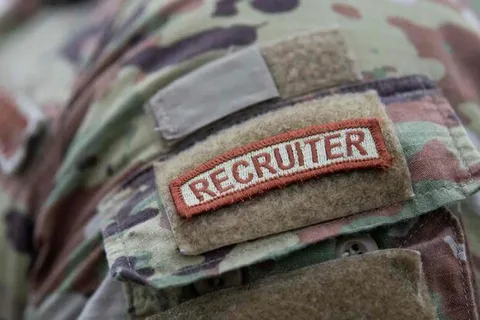
OCP patches are the insignia that give you your identity based on your rank, skills, and units. They are used by the US military personnel and attached to the Operational Camouflage Pattern military uniform. Its placement is as important as getting the one because just one wrong OCP patch placement can make your whole uniform look off and can misguide people about your rank.
Too many rules and wrong online information can make anyone confused and worried about looking unprofessional if the patch placement is slightly wrong. That is why learning correct rules about Army OCP placement is essential. Although there is much information present, it still makes people confused. In this blog, I will tell you every little detail that will make the process of OCP patch placement smooth.
Complete Army OCP Patch Placement Guide
The OCP patch placement is important as it shows professionalism and respect for the uniform. Not only this it also makes you look disciplined. A precise OCP patch placement guide is necessary for soldiers and beginners. It avoids errors, saves time, minimizes confusion, and gives it a professional look. It clarifies the proper positioning of name tapes, rank, unit patches, flags, badges, and tabs, and thus everyone is able to operate within regulation and apply it correctly.
U.S. Army Flag OCP Patch Placement
The U.S. Army OCP patches are part of the uniform for every U.S. Army soldier. They should be placed on the right shoulder and in a reverse direction. Although this is the common style of placing them, still, people are still confused and always ask why it should be placed in a reverse direction. The answer is wearing it in reverse will give the feeling of the flag flying backward in the wind as the soldier moves forward.
Where should army unit patches be placed?
Although formerly the unit military patches were placed on the right shoulder, currently the soldiers place them on the left shoulder, which is according to the Army Regulation 670:1. While the type of unit patch that is a combat patch should be placed on the right sleeve just below the Army OCP patch. These SSI-FWTS (Shoulder Sleeve insignia- Former Wartime Service) are the coolest army unit patches, which show that they were part of the combat operations and represent their ranks there.
U.S. Army Tape And Name Tape Placement
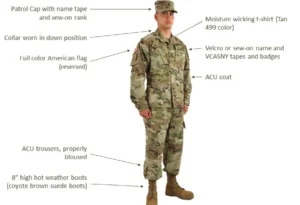
The left chest bears the U.S ARMY tape, and the right one bears the name tape. In the middle of them is the rank patch. Rank insignia are used to indicate a rank in officers, and enlisted soldiers carry their enlisted rank.
Spacing Tip For Your Coolest Army Unit Patch
The distance between patches is important for an organized look. And it must be ½ horizontally to 1/4 inch vertically between the two badges according to Civil Air Patrol guidelines. No matter whether it is an Airborne wings, a CIB, or a medical badge, clean spacing ensures your uniform is sharp. It is one of the minor details that most people overlook, but soldiers should take care of this.
Clear Sequence Guide For Air Force OCP Patch Placement
Follow these simple steps to achieve correct air force OCP patch placement
- Place the name tape on the right side of the chest.
- The U.S. Army tape is on the left side of the chest.
- Place the rank tape between the above two and
- The U.S. flag patch should be on the right shoulder, and the current unit patch should be on the right shoulder.
- Special unit OCP patches, such as Rangers, should be placed above the shoulder patches.
- Lastly, among the optional Army OCP patches combat patch is placed on the right shoulder, and the skill badge patch is deployed on the chest pocket.
Different OCP Patches Placement On Jackets, Field Gear, and Non-Uniform Clothing
OCP patches do not only feature on regular Army uniforms, but they are also found on jackets, field gear, and casual or veteran gear. But, it is equally important to know how to place them in a proper way in order to look professional and stylish, even if you are not a soldier.
Sew on vs. Velcro Patches
Sew-on patches are long-term term permanent patches and may be used in uniform or collector displays. However, Velcro patches are more flexible, and the unit patches, skill badges, or morale patches can be changed very fast by the soldier. Most modern uniforms, jackets, and other old clothing have Velcro panels placed on them.
Casual or Veteran Wear Rules
The patches of old-style clothing that were used by veterans or military enthusiasts are OCP patches. Although no real rule is implied when soldiers are not on active duty, it is advisable to stick to the meaning of patches. And wear them in a way that does not degrade service, does not mislead people with wrong insignia, and looks presentable. For example, a veteran may put on his old unit patch, Airborne tab, or a minor flag on a jacket, and maintain a significant order of placement.
Collectors and Display
It is known that patches are often framed, attached to boards, or put into shadow boxes by collectors. This ensures secure storage and shows historical significance. When placed in this way, it is easy to organize patches in units, deployment, or badge type, and maintain the aura and the look.
Getting to know about these differences would represent that patches should be worn or displayed with respect, whether they are on uniform, gear, casual clothing, or are just a part of a collection. The pride and professionalism of every insignia have remained alive in this way.
Common Mistakes to Avoid
The most common mistake that people make is to wear the U.S flag on the wrong shoulder, while it must always be put on the right. Well, this is not their fault, as the rules and details are so confusing that anyone can be mistaken.
Wrong badge spacing is also noticed among people, as slight misplacement will affect the real purpose of a uniform. The placement of Army patches is mixed up with the Air Force regulations, resulting in the misplacement of unit patches or tabs by many soldiers.
Another error is the use of bright colored patches instead of dull colors, particularly in the field operations. These details will help you to appear professional, within the regulations, and show your pride in serving your country.
Bonus Tips for OCP Patch Placement
OCP patches can be made to look sharp and used for years through proper care. When following cleaning instructions, which are usually soft washing and air drying to avoid damage. Storage is also important; patches should be stored flat or pressed on Velcro boards so that they do not bend.
Picking up the right OCP patch is also important. Here are a few things that you should see. Velvet patches go well with active uniforms or field gear because they can be changed easily, whereas sew-on patches are more suitable in permanent locations or in the collectors’ display. By sticking to these rules, you will have professional patches that are durable and have proper placement, no matter whether you are on or off duty, in or out of the field, or on a casual basis.
Conclusion
Placement of OCP patches is not just a method, but it is also an expression of discipline, pride, and professionalism. Each patch, badge, and medal has a story of service, expertise, and hard work. These details do matter whether you are a new soldier, an old one, or a collector. Make sure that your uniform or clothing has the correct patch. It will help you look confident.
FAQs
1- What are the military patches?
Answer: Patches refer to your unit, history of deployments, skills, and qualifications. They represent honor, service, and professional accomplishments.
2- Where do I place name patches in the OCP uniform?
Answer: Name tape on right chest, name U.S. ARMY tape on left chest, and rank in the middle of these two. The right shoulder should have the U.S. flag.
3- What OCP patches go where?
Answer: Existing unit patch will be placed on the left shoulder. The combat patches must be on the right shoulder. Special tabs and skill badges are worn over the pockets on the chest or shoulder patches.
4- What is the correct Army OCP patch placement for the U.S. flag?
Answer: The U.S. flag OCP patch should be placed on the right shoulder. And it should be worn in the reverse direction, showing that the flag is moving forward.
5: What are some of the coolest Army unit patches to wear on OCP?
Answer: Some of the coolest army unit patches are 101st Airborne “Screaming Eagles,” 82nd Airborne “All American,” 1st Infantry Division “Big Red One,” and 1st Cavalry Division.